

RFID stands for Radio Frequency Identification. In the hotel lock industry, there are two main RFID card technologies still widely used today:
Understanding the differences between these two technologies is essential when choosing the right hotel lock solution.
What Is a Temic 57 Card?
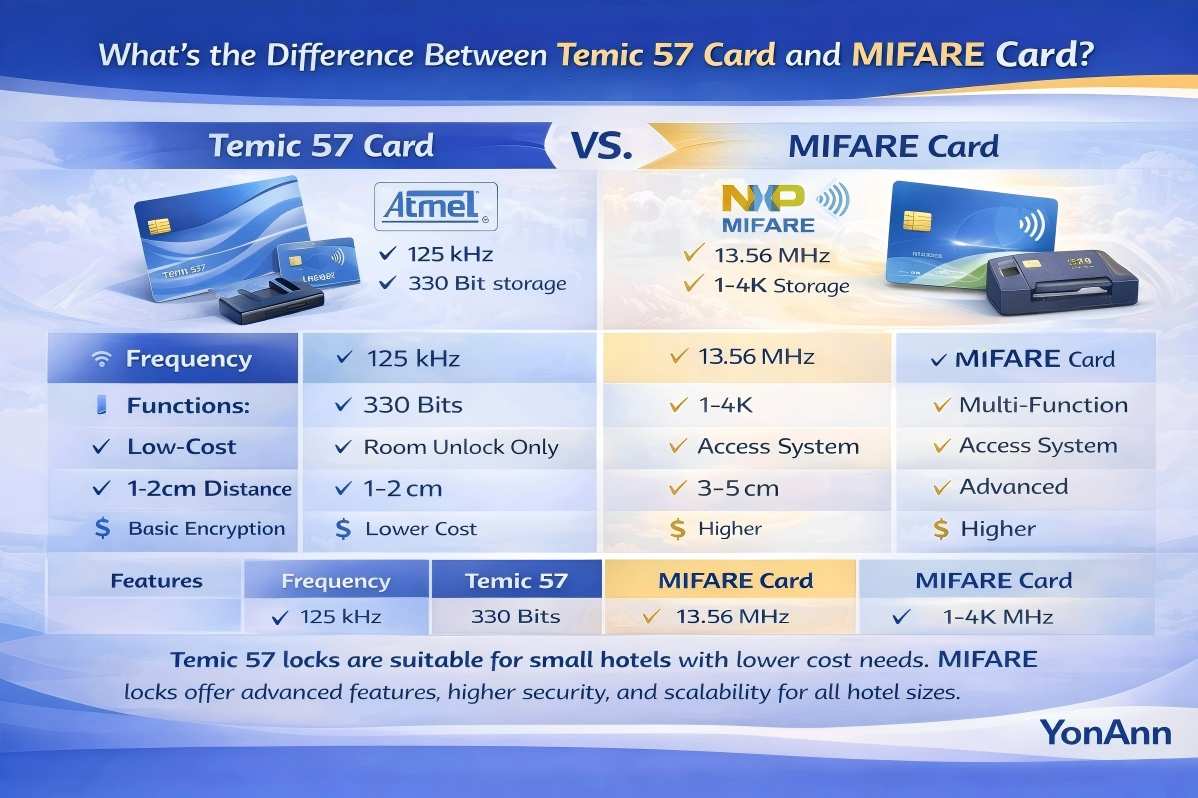
The Temic 57 card uses the Atmel T5577 chip, operating at a low frequency of 125 kHz with approximately 330 bits of memory.
Temic 57 cards are:
-
Low-cost RFID cards
-
Readable and writable
-
Able to perform basic encryption for read/write operations
They are commonly used in basic access control systems and entry-level RFID hotel locks where system expansion and advanced security are not required.
What Is a MIFARE Card?
MIFARE cards are produced by NXP (formerly Philips) and operate at a high frequency of 13.56 MHz. They are widely used not only in hotels, but also in public transportation systems, parking, payment systems, and access control applications worldwide.
Common MIFARE card types include:
-
MIFARE Classic 1K (S50)
-
MIFARE Classic 4K (S70)
A MIFARE card is a multi-application smart card. For example, one MIFARE S50 card contains 16 sectors, allowing it to function like multiple cards in one. This enables room access, elevator control, parking access, energy-saving switches, and consumption management to operate on a single card.
Due to advanced encryption and authentication mechanisms, MIFARE cards cannot be easily copied, making them suitable for medium to high-end hotels.
System Compatibility: Temic vs MIFARE
-
Temic hotel locks use:
-
T57 card chip PCB
-
T57 cards
-
T57 card encoder
-
125 kHz energy-saving switches
-
-
MIFARE hotel locks use:
-
MIFARE chip PCB
-
MIFARE cards
-
MIFARE card encoder
-
13.56 MHz energy-saving switches
-
⚠️ Important: Temic and MIFARE systems cannot be mixed. Locks, cards, encoders, energy-saving switches, and software must all use the same technology. Additionally, different hotel lock manufacturers apply their own encryption methods, so systems from different suppliers are also not interchangeable.
How to Choose: Key Differences Explained
1️⃣ Functions & Extended Applications
Temic 57 Hotel Lock
-
Mainly used for room door unlocking only
-
Limited system expansion
-
Not suitable for all-in-one access systems
MIFARE Hotel Lock
-
Supports room access + elevators + parking + SPA + gym + restaurants
-
One card for multiple areas (“One Card Access System”)
-
Ideal for large hotels, resorts, and integrated properties
2️⃣ Data Collection & Management
Temic System
-
Requires a separate data collection device
-
Data must be manually uploaded to the computer
MIFARE System
-
Uses a MIFARE 4K (S70) data collection card
-
Faster, easier, and more flexible record retrieval
3️⃣ Security & Reliability
MIFARE hotel locks offer higher security than Temic systems.
-
Advanced sector-based encryption
-
Each sector and block has its own authentication key
-
Strong anti-collision mechanism
-
Excellent resistance to signal interference
-
Proven stability in large-scale deployments
Temic cards can be encrypted, but are easier to decrypt using specialized devices.
4️⃣ Reading Distance & Performance
| Technology | Reading Distance |
| Temic 57 (125 kHz) | 1–2 cm |
| MIFARE (13.56 MHz) | 3–5 cm |
In metal hotel lock housings, high-frequency MIFARE cards maintain better performance, improving user experience.
5️⃣ Cost Comparison
-
Temic hotel lock systems are more economical
-
MIFARE hotel lock systems cost more due to:
-
Higher chip cost
-
Advanced encryption
-
Multi-application capability
-
However, the long-term value and scalability of MIFARE systems often outweigh the initial cost difference.
Feature Comparison Table
| Item | Temic 57 Hotel Lock | MIFARE Hotel Lock |
| Working Frequency | 125 kHz | 13.56 MHz |
| Chip Brand | Atmel T5577 | NXP MIFARE S50 / S70 |
| Storage Capacity | 264–330 bits | 1K / 4K |
| Multi-Application | ❌ No | ✅ Yes |
| Working Distance | 1–2 cm | 3–5 cm |
| Data Stability | Medium | Very High |
| Security Level | Basic encryption | Advanced DES/AES |
| Card Lifetime | ≥100,000 cycles | ≥100,000 cycles |
| Elevator Control | Supported | Supported |
| Energy Saving Switch | Supported | Supported |
| Overall Cost | Lower | Higher |
Conclusion: Which One Should You Choose?
-
Choose Temic 57 hotel locks for:
-
Budget hotels
-
Small properties
-
Simple room-access needs
-
-
Choose MIFARE hotel locks for:
-
Medium & large hotels
-
Resorts and apartments
-
Projects requiring high security, scalability, and one-card access
-
At YonAnn, we provide both Temic and MIFARE hotel lock solutions, and help you choose the right system based on your project size, budget, and future expansion needs.
 English
  Russian
  Spanish
  Arabic
  Vietnamese