


At CES 2026, the smart home sector received exceptional attention. Among all categories, smart door locks stood out as one of the most structurally transformed product segments. From Chinese innovators to established Western brands, a wave of new launches demonstrated not incremental upgrades, but a fundamental shift in product logic.
If earlier generations of smart locks competed on more unlocking methods or premium aesthetics, CES 2026 revealed a new industry consensus:
Smart locks are evolving from electronic hardware into home entry-level infrastructure.
This transformation is driven by three major forces: battery technology, connectivity standards, and identity recognition.
-
Beyond Frequent Charging: Battery Technology Enters the “Infrastructure” Era
1.1 Battery Life Is No Longer a Specification — It’s a User Experience Baseline
For years, frequent battery replacement or charging has been one of the biggest pain points of smart locks. Whether for homeowners or B2B users, such as apartments, hotels, and commercial buildings, a deadlock means a complete loss of trust.
1.2 Multiple Breakthrough Paths in Power Supply Technology
Wireless Over-the-Air Charging: Truly Invisible Power
The Lockin (Loock) V7 Max attracted strong attention as the world’s first mass-produced over-the-air charging smart lock, powered by AuraCharge wireless optical charging technology.
Key highlights include:
-
Stable power delivery within a 4-meter range
-
No physical contact, no charging dock
-
Continued operation even when the transmitter stops temporarily
This innovation is not just a technological showcase. It fundamentally shifts smart lock power supply from active maintenance to environment-based energy, opening new possibilities for villas, luxury residences, and commercial projects.
Solar Charging: Moving Toward Near-Perpetual Operation
Desloc V150 Plus introduced a different approach by integrating perovskite solar panels.
Compared with traditional solar solutions, this technology offers:
-
Higher efficiency in low-light environments
-
Continuous charging even on cloudy days or in semi-indoor entrances
-
No compromise to industrial design
This solution is particularly suitable for villas, community entrances, and low-maintenance installations, signaling that smart locks are beginning to adopt semi-passive device characteristics.
High-Capacity Batteries Become the New Standard
At the same time, large-capacity battery designs are rapidly becoming mainstream:
-
SwitchBot Lock Vision: up to 6 months of battery life
-
Eufy E40: dual-battery architecture with a 15,000mAh main battery plus an 800mAh backup battery
This design philosophy, inspired by automotive and server redundancy systems, prioritizes reliability in extreme scenarios rather than theoretical battery life numbers.
1.3 Trend Summary: From Power-Hungry Device to Long-Term Operating Node
Looking ahead, battery performance will no longer be a marketing highlight—it. It will be a market entry requirement. Smart locks that fail to eliminate power anxiety will gradually exit the mid-to-high-end market.
-
Matter Becomes Standard: Matter Smart Locks Shift from Isolated Devices to Ecosystem Hubs

2.1 Matter Support Is No Longer Optional
At CES 2026, almost all major smart lock launches offered native Matter support, such as Eufy E40, Lockly Affirm, Ultraloq Bolt Sense, Aqara U400, Yale Linus L2 Lite
The signal is clear:
Smart locks without Matter support are being marginalized.
2.2 Matter Is More Than Compatibility
Developed by the Connectivity Standards Alliance (CSA), Matter is an IP-based, open smart home standard designed to enable cross-brand interoperability.
Its deeper impact goes far beyond connecting more apps:
For users:
-
No forced ecosystem lock-in (Apple, Google, Amazon, Tuya)
-
Lower decision risk and reduced platform anxiety
For manufacturers:
-
Reduced system development and maintenance costs
-
Faster global market access
-
Significantly longer product life cycles
2.3 The Role of Smart Locks Is Changing
Within the Matter ecosystem, smart locks are no longer passive-controlled devices. They are becoming core automation triggers, enabling scenarios such as:
-
Unlocking the door → lights, curtains, and HVAC activate
-
Different family members → personalized scenes load automatically
-
Leaving or returning home → security modes switch seamlessly
This marks a fundamental shift in value—from control ownership to connectivity capability.
-
The Rise of Contactless Unlocking: Biometrics Enter the Experience Era
3.1 From “Can Recognize” to “Feels Natural.”
Fingerprint recognition solved the “no key” problem.
The biometric technologies showcased at CES 2026 aim for something deeper:
Make the act of unlocking disappear entirely.
3.2 Two Clear Technical Routes in High-End Products
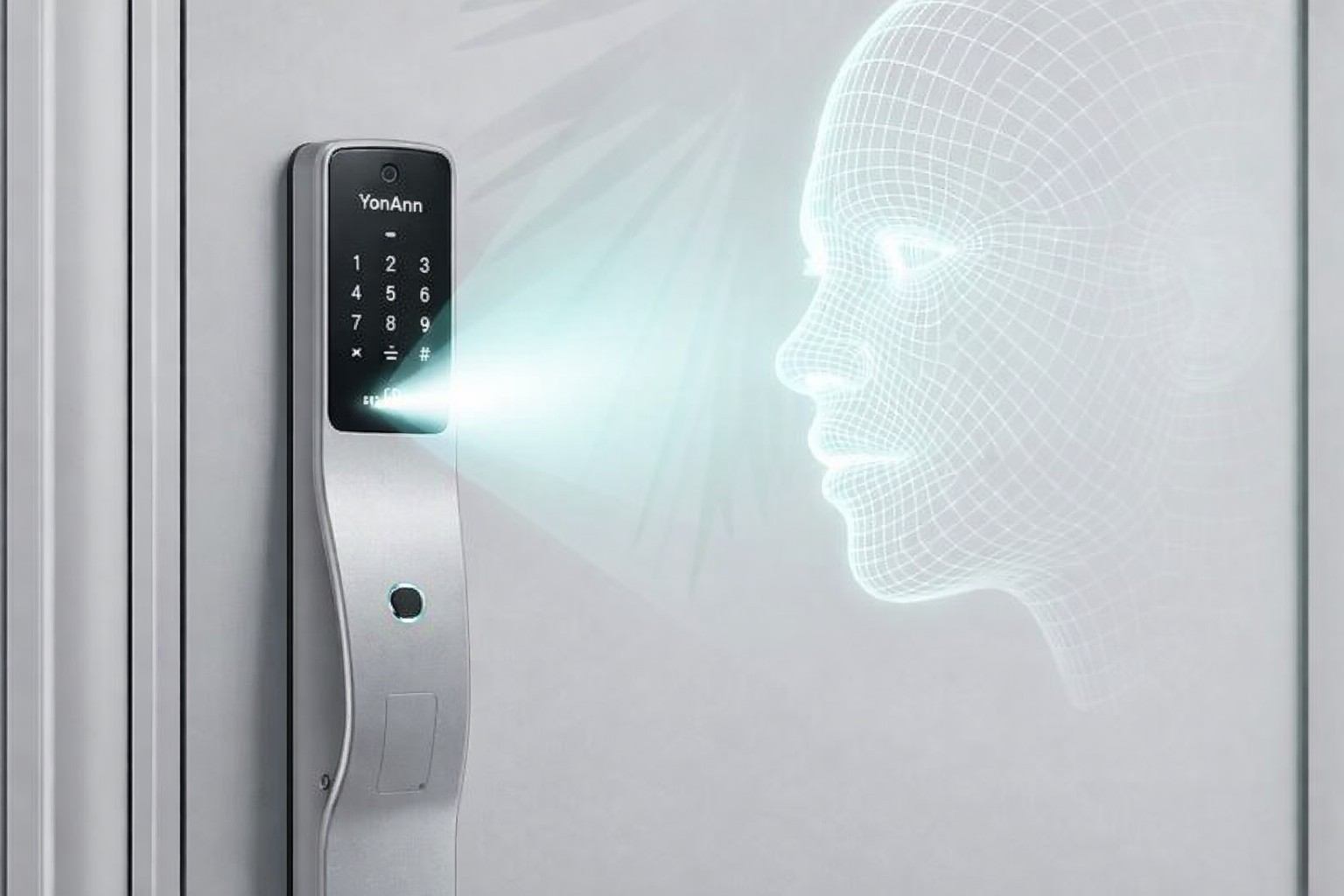
3D Facial Recognition Smart Lock: Precision and Security First
Represented by SwitchBot Lock Vision:
-
3D facial modeling using 2,000 infrared points
-
Strong emphasis on accuracy and anti-spoofing
-
Natural “look-and-unlock” interaction
This approach is ideal for high-security residential entrances.
Palm / Vein Recognition: Environmental Adaptability First

-
Unaffected by wet hands or gloves
-
Works even when hands are occupied
-
Higher stability in complex environments
3.3 The Future of Biometrics: A Unified Digital Identity
The most significant shift lies beyond unlocking. Biometrics are evolving into home digital identity systems:
-
Face or palm = user ID
-
Automatic matching of permissions, scenes, and device configurations
-
Smart locks become the identity gateway of the smart home
In the future, smart locks won’t simply decide whether you can enter, but:
Who you are—and how your home should respond to you.
Conclusion: The Next Phase of Smart Locks Is Not Smarter — It’s More Fundamental
CES 2026 delivered a clear message to the smart lock industry:
-
Battery life must be long-term and reliable
-
Connectivity must be open and universal
-
Identification must be natural and effortless
Smart locks are transitioning from smart hardware into foundational entry infrastructure for homes and buildings. Those who complete this shift in product logic and system thinking earliest will secure the true gateway position in the future smart home ecosystem.
 English
  Russian
  Spanish
  Arabic
  Vietnamese