

 Hotel door lock technology has undergone a decisive transformation over the past two decades. What began with mechanical keys has evolved into High-Frequency (HF) RFID and online hotel lock systems, now recognized as the global standard for modern hospitality.
Today, professional hotels no longer ask whether to use RFID locks—but which architecture, card technology, and system level best aligns with long-term operations, security, and scalability.
This guide provides a complete, up-to-date, and industry-accurate explanation of hotel RFID lock systems, reflecting current mainstream practices, not outdated legacy solutions.
What Is a Hotel RFID Lock System?
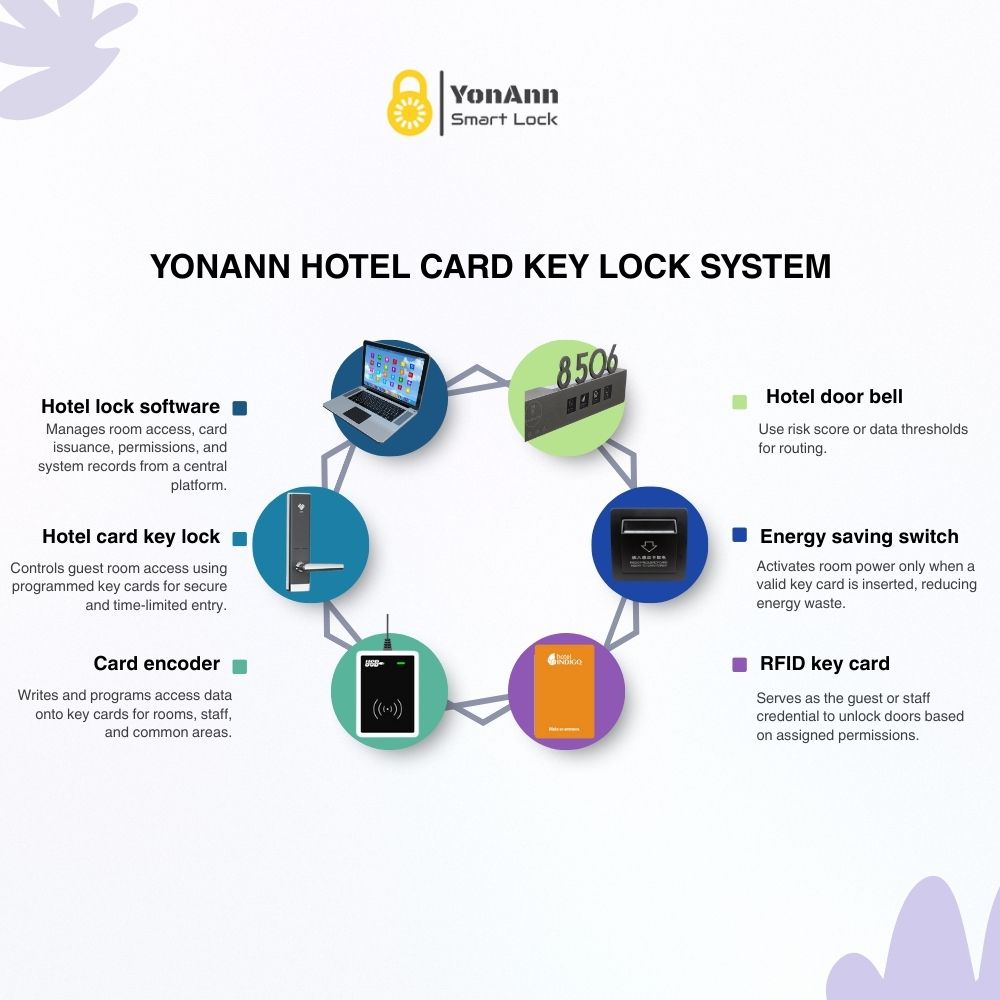 A Hotel RFID Lock System is an electronic door access solution that uses radio frequency identification (RFID) to authenticate guests and staff through contactless key cards.
Instead of physical metal keys, guests use RFID cards encoded with digital access credentials, allowing hotels to control:
- Which room can be accessed
- During what time period
- By which user level
Unlike traditional locks, RFID systems allow centralized management, instant key cancellation, and audit trail tracking, making them ideal for hospitality environments with high guest turnover.
How a Hotel RFID Lock System Works
An RFID hotel lock system operates through a secure, time-based authorization mechanism.
Standard Guest Access Workflow
- Guest checks in at reception
- The front desk encodes an RFID card with:
- Room number
- Check-in / check-out time
- The guest presents the card to the door lock
- Lock reader scans encrypted data
- Controller verifies authorization
- Door unlocks
- The access record is stored in memory
This process typically takes less than one second and works even without internet connectivity, which is a key advantage over mobile-only systems.
Core Components of a Hotel RFID Lock System
A complete RFID system consists of hardware + software, + management tools.
RFID Hotel Door Lock
The door lock is the core hardware component, integrating:
- RFID reader module
- Control board
- Motor and mechanical mortise
- Battery power system
- Memory chip for event records
Modern hotel RFID locks are designed for:
- Offline operation
- Long battery life (12–18 months)
- Harsh environments (humidity, dust, coastal air)
RFID key cards act as digital credentials.
They store:
- Encrypted identification data
- Room or access zone
- Valid time period
Common card formats include:
- Standard PVC cards
- Eco-friendly paper or wooden cards
- Custom-branded hotel cards
Cards can be:
- Reissued instantly
- Deactivated remotely (online systems)
- Blacklisted if lost
The encoder is installed at the front desk and is used to:
- Program RFID cards
- Assign room access
- Set validity periods
- Update staff permissions
Encoders typically connect to:
- Hotel lock management software
- PMS systems (optional but recommended)
Front desk efficiency heavily depends on encoder speed and stability.
This software acts as the central control system, allowing hotels to:
- Manage rooms and buildings
- Create guest and staff cards
- Define access hierarchies
- Review unlock history and audit logs
Advanced software supports:
- Multi-property management
- Cloud-based deployment
- Integration with PMS, elevators, and energy-saving systems
Network Modules & Optional Accessories
Depending on system architecture, hotels may use:
- Wireless gateways
- Wired networking
- Handheld data collectors
These enable:
- Real-time monitoring
- Centralized data synchronization
- Remote troubleshooting
Hotels can choose offline, semi-online, or fully online RFID systems based on budget and operational needs.
Types of RFID Cards Used in Hotel Lock Systems
Mechanical Key Locks (Legacy – Already Eliminated in Modern Hotels)
Mechanical locks were once the foundation of hotel security, but are now largely eliminated in professional hospitality projects.
Why Mechanical Locks Are No Longer Viable
- Keys can be easily copied
- Lost keys require cylinder or lock replacement
- No access records or audit trail
- No time-based control
- High long-term maintenance cost
Current Industry Status
Mechanical locks are now limited to:
- Very small guesthouses
- Extremely low-budget properties
- Temporary or non-commercial use
From a modern hotel management and security perspective, mechanical locks are obsolete.
Magnetic Stripe Hotel Locks (Declining & Being Phased Out)
Magnetic stripe hotel locks represented the first step toward electronic access control, but are now rapidly disappearing from the market.
Key Characteristics
- Data stored on a magnetic stripe
- The card must be physically swiped
- Vulnerable to demagnetization
Why Magnetic Stripe Locks Are Being Replaced
- Cards fail frequently
- Readers wear out mechanically
- Higher operational disruption
- Poor guest experience
- Inferior security compared to RFID
Current Industry Status
Magnetic stripe systems are:
- No longer recommended for new hotel projects
- Mostly found in old installations awaiting upgrade
Most hotel groups now consider magnetic stripe locks a transitional technology, not a long-term solution.
Low-Frequency (LF) RFID Cards – 125KHz
(Being Eliminated from Professional Hotel Projects)
Low-frequency RFID locks were once popular due to low cost, but they are now being phased out.
Technical Overview
- Frequency: 125KHz
- Short read distance
- Basic data storage
- Minimal encryption
Limitations That Lead to Elimination
- Weak security and easy duplication
- Limited compatibility with modern systems
- Poor scalability
- Not suitable for online or cloud-based systems
Current Industry Reality
LF RFID hotel locks are:
- Rarely used in new projects
- Mostly limited to very low-budget hotels
- Increasingly unsupported by advanced software platforms
From an industry standpoint, LF RFID hotel locks are no longer future-proof and should be avoided in new installations.
High-Frequency (HF) RFID Cards – 13.56MHz
(Current Mainstream Standard for Hotel Locks)
High-frequency RFID cards have become the global mainstream technology for hotel lock systems.
Technical Overview
- Frequency: 13.56MHz
- Encrypted communication
- Stable and fast authentication
- Long card lifespan
Why HF RFID Is the Industry Standard
- High security and encryption
- Excellent compatibility with PMS systems
- Suitable for both offline and online architectures
- Durable, contactless user experience
- Strong supplier ecosystem and long-term support
Typical Applications
- Mid-scale hotels
- Business hotels
- Resorts
- International hotel chains
Today, when professionals refer to an “RFID hotel lock system,” they almost always mean a High-Frequency RFID system.
 Online Hotel Lock Systems (Mainstream Direction, Not a Separate Card Type)
It is important to clarify:
“Online hotel lock system” is not a card technology, but a system architecture.
Most modern online hotel lock systems are built on HF RFID card technology.
Offline vs Online Hotel RFID Lock Systems
Offline HF RFID Hotel Lock System
- Locks operate independently
- Access data stored locally
- Periodic data collection (via encoder or handheld device)
Suitable for:
- Small to mid-size hotels
- Projects prioritizing stability and cost control
Online HF RFID Hotel Lock System (Mainstream Trend)
Online hotel lock systems connect locks to a central platform via:
- Wired network
- Wireless gateways
- Hybrid architectures
Advantages of Online Hotel Lock Systems
- Real-time access control
- Instant card cancellation
- Live audit trails
- Centralized management
- Easier multi-property operation
Typical Use Cases
- Medium and large hotels
- Chain hotels
- Resorts
- Smart hotel projects
Online hotel door lock systems based on HF RFID are now the preferred choice for professional hospitality projects.
Technology Positioning Summary (Clear Industry Consensus)
| Technology | Industry Status |
| Mechanical locks | Eliminated |
| Magnetic stripe locks | Being phased out |
| LF RFID (125KHz) | Near end-of-life |
| HF RFID (13.56MHz) | Current mainstream |
| Online HF RFID systems | Future-proof standard |
Benefits of RFID Lock Systems for Hotels
For hotels, an RFID lock system is not merely a door-opening tool. In practice, it directly influences daily operations, security governance, guest satisfaction, staff efficiency, and long-term cost structure.
Compared with mechanical keys, magnetic stripe locks, and legacy systems, modern HF RFID (13.56 MHz) hotel lock systems—especially online architectures—deliver measurable operational and commercial advantages across the entire hotel lifecycle.
Operational Efficiency: Reducing Daily Friction at Scale
One of the most immediate benefits of RFID lock systems is operational simplification.
In traditional mechanical or magnetic stripe systems:
- Lost keys cause delays and disputes
- Replacing locks or reissuing keys is time-consuming
- Front desk staff handle frequent exceptions manually
With an RFID system:
- Key cards are issued in seconds
- Lost cards are invalidated instantly
- No physical lock replacement is required
- Check-in and check-out become standardized processes
For hotels with high guest turnover, this efficiency compounds daily—especially during peak seasons.
Operational reality: Even a 30–60 second reduction per check-in translates into hours of saved labor per week in mid-to-large hotels.
Security Control: From “Trust-Based” to “System-Based”
Mechanical locks rely on physical control of keys, which is inherently insecure. RFID systems shift hotels toward policy-based, time-controlled access management.
Key security advantages include:
- Time-limited access automatically expires at check-out
- Immediate deactivation of lost or stolen cards
- Differentiated access levels (guest/housekeeping/maintenance/management)
- Stored unlock records for audits and dispute resolution
In online RFID systems, security control becomes even stronger:
- Real-time card blacklisting
- Live monitoring of abnormal access attempts
- Centralized control across floors or buildings
This significantly reduces:
- Unauthorized room access
- Insider risk
- Liability in guest complaints or insurance claims
Guest Experience: Invisible Technology That Feels “Premium”
A good hotel technology should not be noticed—it should simply work.
RFID locks improve guest experience by:
- Eliminating physical key handling
- Offering contactless, intuitive access
- Reducing front-desk dependency for common issues
- Supporting smooth late-night or self-service check-ins
Importantly, RFID systems:
- Work for all age groups
- Do not depend on smartphones
- Avoid app downloads or Bluetooth pairing failures
This reliability is why RFID remains the core access method, even in smart hotels that also offer mobile keys.
Staff Workflow Optimization: Less Manual Work, Fewer Errors
From a hotel management perspective, RFID systems significantly improve staff efficiency and accountability.
Examples:
- Housekeeping cards automatically expire after shifts
- Maintenance access can be limited to specific time windows
- Management cards can be tracked and audited
- Temporary staff access can be issued and revoked easily
Online systems further enable:
- Centralized staff permission updates
- Reduced dependency on physical supervision
- Faster onboarding of new employees
This reduces:
- Human error
- Internal disputes
- Operational bottlenecks
Cost Control & Long-Term ROI (Total Cost of Ownership)
While RFID systems may have a higher initial investment than mechanical locks, they deliver a lower total cost of ownership (TCO) over time.
Key cost-saving factors:
- No lock replacement for lost keys
- Lower maintenance frequency
- Reduced front-desk labor pressure
- Longer hardware lifespan
- Scalable upgrades without reinstallation
For chain hotels or expanding properties, online RFID systems also:
- Avoid duplicated systems
- Centralize IT and maintenance resources
- Reduce future upgrade costs
Strategic insight: RFID locks are not an expense—they are infrastructure.
Scalability & Future-Proofing
Modern HF RFID systems are designed to grow with the hotel.
They support:
- PMS integration
- Elevator and access control linkage
- Energy-saving systems
- Hybrid RFID + mobile access
- Smart hotel and IoT platforms
Online RFID architectures, in particular, allow hotels to:
- Expand buildings without replacing systems
- Manage multiple properties from one platform
- Transition gradually into smart-hotel ecosystems
This ensures the hotel’s access system remains relevant for 10+ years, not obsolete after one renovation cycle.
Brand Image & Market Competitiveness
From the guest’s perspective, RFID locks subtly communicate:
- Professional management
- Modern infrastructure
- Security awareness
From the owner’s perspective, they:
- Align the hotel with international standards
- Improve OTA reviews related to “ease of access.”
- Increase perceived room value without visible renovation
In competitive markets, this indirect brand signaling matters.
Summary: Why RFID Lock Systems Are a Strategic Asset
RFID lock systems deliver value on multiple levels:
- Operational: Faster, cleaner daily workflows
- Security: Policy-driven, auditable access control
- Experience: Seamless, contactless guest interaction
- Financial: Lower long-term operational costs
- Strategic: Scalable and future-ready infrastructure
For modern hotels, especially those adopting HF RFID + online architectures, RFID locks are no longer a feature—they are a foundational operational system.
RFID Lock System Architecture by Hotel Type
There is no single “best” hotel lock system for all properties. The correct RFID lock architecture depends on hotel size, staffing model, operational complexity, and cost sensitivity.
A common mistake in the market is over-engineering small hotels or under-engineering large ones. This section explains which lock system architecture truly fits each hotel type—and why.
Small Hotels & Guesthouses
(Cost-Driven, Staff-Light, Management-Oriented)
Typical Characteristics
- 5–30 rooms
- Owner-managed or family-operated
- Minimal front desk staff (or none)
- Strong cost sensitivity
- Preference for simple, phone-based management
For this category, simplicity and low fixed cost matter more than enterprise-level integration.
Suitable Lock System Architectures
✅ Low-Frequency (LF) RFID Hotel Lock Systems
Although LF RFID locks are being eliminated from mid-scale and chain hotels, they still have a valid role in small properties.
Why LF RFID can work here:
- Very low hardware cost
- Simple standalone operation
- No PMS or network dependency
- Sufficient security for limited room counts
Limitations (acceptable in this context):
- Lower encryption
- Limited scalability
- Not future-proof for large expansion
👉 Conclusion: LF RFID locks are acceptable for small guesthouses with stable ownership and low turnover, but should not be used if future expansion is planned.
✅ Bluetooth Digital Door Locks (Phone-Managed)
(Fast-Growing Choice for Small Properties)
Bluetooth hotel locks managed via smartphone apps are increasingly popular among:
- Guesthouses
- Homestays
- Boutique inns
- Short-term rental operators
Key advantages:
- No need for front desk is required
- No need computer or server
- Lock management via mobile app
- Remote key issuance
- Lower staffing costs
This architecture allows owners to:
- Manage access remotely
- Issue digital keys instantly
- Reduce labor dependency
Business reality: For a 10–20 room property, eliminating even one full-time front desk staff can offset the entire lock system cost within months.
Recommended Architecture Summary (Small Hotels)
| Option | Suitable | Why |
| Mechanical locks | ❌ | No control, no efficiency |
| Magnetic stripe | ❌ | Obsolete, unstable |
| LF RFID | ✅ | Low cost, simple |
| Bluetooth locks | ✅ | No staff, no PC |
| Online HF RFID | ⚠️ | Often overkill |
Mid-Scale Hotels
(Operational Balance: Cost, Control, Efficiency)
Typical Characteristics
- 30–150 rooms
- Dedicated front desk staff
- Daily housekeeping teams
- Structured operations
- Moderate IT budget
For this category, LF RFID and pure Bluetooth solutions start to show limitations.
Recommended Architecture: HF RFID (Offline or Semi-Online)
Why HF RFID is the right baseline:
- Higher security and encryption
- Better card reliability
- Staff hierarchy support
- PMS compatibility
- Long system lifespan
Hotels can choose:
- Offline HF RFID for cost control
- Semi-online HF RFID for better data synchronization
Bluetooth locks alone are not recommended at this scale due to:
- Phone dependency
- Staff coordination complexity
- Guest support issues
Operational Benefits at This Level
- Faster front desk workflows
- Cleaner staff permission control
- Fewer guest complaints
- Better auditability
Large Hotels, Resorts & Chain Hotels
(Control, Integration, Scalability First)
Typical Characteristics
- 150+ rooms
- Multiple buildings or floors
- High staff volume
- Strong brand and security requirements
- Multi-property management
For this category, only online-capable HF RFID systems are appropriate.
Recommended Architecture: Online HF RFID Hotel Lock System
Core reasons:
- Real-time access control
- Instant card blacklisting
- Centralized monitoring
- Multi-property scalability
- Seamless PMS, elevator, and energy integration
LF RFID and Bluetooth-only systems are completely unsuitable here due to:
- Security risks
- Management complexity
- Lack of centralized control
Strategic Value for Chains
- Unified access policies
- Standardized guest experience
- Lower long-term IT cost
- Easier compliance and auditing
Architecture Selection Matrix (Clear & Honest)
| Hotel Type | Best-Fit Architecture |
| Guesthouse / Homestay | LF RFID or Bluetooth |
| Small Hotel (≤30 rooms) | Bluetooth or Offline RFID |
| Mid-Scale Hotel | HF RFID (Offline / Semi-online) |
| Large Hotel / Resort | Online HF RFID |
| Chain Hotels | Online HF RFID + PMS |
Key Insight: Architecture Follows Business Model
The correct question is not:
“What is the most advanced hotel lock?”
The correct question is:
“What level of control and cost structure does this hotel actually need?”
- Small hotels win by reducing fixed costs
- Mid-scale hotels win by balancing control and efficiency
- Large hotels win by centralized, real-time management
RFID and digital lock systems should serve the business, not complicate it.
Key Technical Specifications Buyers Must Understand (Quick Guide)
When choosing a hotel RFID lock system, buyers should focus on five core technical specifications that directly impact security, reliability, and long-term cost.
- RFID Frequency & Card Type High-Frequency (13.56 MHz) RFID is the industry standard, offering encrypted communication, strong anti-duplication protection, and wide compatibility. Low-frequency systems lack scalability and security.
- Lock Memory Capacity Locks must store sufficient access and event records for audits, troubleshooting, and dispute resolution—especially in hotels with high guest turnover.
- Battery Life & Power Management Reliable systems provide long battery life, low-battery warnings, and emergency power access to avoid service interruptions.
- Encryption & Security Control Encrypted authentication and card blacklisting are essential to prevent unauthorized access, particularly in online hotel lock systems.
- System Expandability Future-ready locks should support upgrades such as online connectivity, mobile access, PMS integration, and energy-saving systems.
Bottom line: Choose HF RFID locks with secure encryption, strong power design, sufficient memory, and upgrade capability to avoid premature system replacement and hidden operational costs.
Installation Considerations for RFID Hotel Locks
Successful RFID hotel lock installation depends on four critical factors.
- Door Compatibility: Confirm door material (wood, metal, fire-rated, glass), thickness, opening direction, and edge clearance before selecting the lock.
- Mortise & Hardware Matching: Verify mortise standard (ANSI, EU, DIN), handle spacing, and latch alignment to prevent unlocking failure or mechanical wear.
- Power & Cabling Preparation: Check battery type, contact stability, low-battery alerts, and cable routing for online systems to ensure reliable operation.
- Software Configuration & Testing: Configure room numbers, access time, staff levels, and PMS settings, then fully test before guest use.
Bottom line: Correct pre-installation checks and proper commissioning are essential to ensure long lock lifespan, stable performance, and minimal maintenance.
Maintenance, Troubleshooting & Lifecycle Costs
Maintenance and lifecycle management play a decisive role in the true cost and reliability of a hotel RFID lock system. While modern RFID locks are designed for durability, hotels must understand how routine upkeep and system design affect long-term performance and operating expenses.
Routine maintenance is relatively simple but essential. This includes periodic battery replacement, reader surface cleaning, and basic functional checks. High-quality RFID locks typically offer 12–18 months of battery life, along with low-battery warnings to prevent unexpected lockouts.
Troubleshooting is significantly easier compared to mechanical or magnetic stripe systems. Common issues—such as cards not being recognized or locks not responding—are usually related to expired cards, low battery levels, or incorrect software settings rather than hardware failure. Online hotel lock systems further reduce downtime by enabling remote diagnostics, real-time alerts, and instant card invalidation.
From a financial perspective, RFID systems offer a lower total cost of ownership (TCO) over their lifecycle. Hotels avoid recurring costs such as lock cylinder replacement, frequent card failures, and high labor intervention. Additionally, scalable RFID platforms allow future upgrades—such as online connectivity or mobile access—without replacing the entire system.
Over an 8–10 year lifecycle, well-maintained RFID lock systems consistently outperform legacy solutions in cost efficiency and operational stability.
The Total Cost of Ownership
The Total Cost of Ownership (TCO) of a hotel lock system goes far beyond the initial purchase price. While mechanical or low-end systems may appear cheaper upfront, they often generate higher long-term costs through frequent maintenance, lock replacement after key loss, and increased labor requirements. Modern RFID hotel lock systems reduce TCO by enabling instant card reissuance, minimizing hardware wear, and lowering daily operational workload. Battery-powered RFID locks also eliminate complex wiring costs, while scalable architectures allow future upgrades—such as online connectivity or mobile access—without full system replacement. Over an 8–10 year lifecycle, RFID lock systems typically deliver lower operating costs, higher stability, and better return on investment compared to legacy access solutions.
How to Choose the Right Hotel RFID Lock Supplier
Choosing the right hotel RFID lock supplier is as important as selecting the lock technology itself. A reliable supplier directly affects system stability, project delivery, and long-term operational support.
First, evaluate whether the supplier is a manufacturer or a trading company. Manufacturers with in-house R&D typically offer better firmware control, faster problem resolution, and long-term product continuity—critical for hotels planning multi-year operation or future expansion.
Second, assess the supplier’s technical capability and system maturity. A professional supplier should provide stable lock hardware, proven lock management software, and clear options for offline and online system architectures. Compatibility with PMS systems and upgrade paths should be clearly defined, not vague promises.
Third, consider OEM / ODM capability. For hotels, chains, or distributors, the ability to customize lock appearance, card design, software language, and branding adds long-term value and differentiation.
Fourth, review after-sales support and documentation. Installation guides, troubleshooting manuals, remote technical assistance, and spare parts availability are essential for minimizing downtime.
Finally, examine the supplier’s project experience and market focus. Suppliers with real hotel project references, especially in similar regions or hotel types, are far more reliable than those selling generic smart locks.
Future Trends of Hotel RFID Lock Systems
Hotel RFID lock systems are evolving from standalone access tools into core infrastructure for smart, data-driven hospitality operations. While High-Frequency (13.56 MHz) RFID remains the foundation, future development focuses on connectivity, integration, and operational intelligence.
One major trend is the widespread adoption of online and cloud-based lock management. Hotels increasingly prefer centralized platforms that allow real-time access control, remote diagnostics, and multi-property management. This reduces on-site IT workload and improves operational visibility, especially for hotel groups and resorts.
Another important direction is hybrid access models. RFID key cards will continue to dominate due to their reliability and universal usability, but they are now commonly combined with mobile keys, Bluetooth, or NFC to give guests flexible access options without abandoning physical cards.
Integration with smart hotel ecosystems is also accelerating. RFID lock systems are being linked with PMS platforms, elevator control, energy-saving systems, and in-room automation, enabling coordinated guest experiences and reduced energy consumption.
Finally, hotels are prioritizing future-proof hardware and software architectures. Systems that support firmware upgrades, modular networking, and open integration standards are favored, ensuring that today’s RFID investments remain relevant over a 10-year operational lifecycle.
Conclusion
Hotel RFID lock systems have become a core infrastructure for modern hospitality, shaping daily operations, security management, guest experience, and long-term cost control. As the industry moves decisively toward High-Frequency RFID and online-capable architectures, hotels that invest in proven, scalable systems gain not only operational efficiency, but also future readiness for smart-hotel integration and multi-property management.
Choosing the right technology is only half of the equation—the supplier’s capability and experience are equally critical. As an experienced hotel lock manufacturer, YonAnn brings strong advantages to hotel projects worldwide, including in-house R&D, mature RFID hotel lock systems, flexible offline and online solutions, and comprehensive OEM / ODM support. With extensive export experience and proven deployments across different hotel types and regions, YonAnn understands real-world installation, operation, and lifecycle requirements—not just product specifications.
By combining the right RFID lock architecture with a reliable supplier, hotels can build a secure, efficient, and future-proof access system that supports sustainable growth over the next decade.
 English
  Russian
  Spanish
  Arabic
  Vietnamese